Home Books of Poems
- Another Victory, By George! (2007)
- Connected Words (2005)
- Somber Reunion (1989)
New Poems 2008 Election Poster
Swiss Critique of Work
Poemes en Francais
About the Author Contact
 
September 3, 2004

The House that Words Built

by Rochelle Riservato and Wavy Davy
BlueStone Press, Ulster County NY


Poet and great-grandson of Ralph Waldo Emerson, Alec Emerson took a most circuitous route to his current vocation. A self-described former "itinerant carpenter," he found the words, or the words found him, to bloom late as a poet and reader of his work.

Originally from New England, Alec finds inspiration by reflecting on times and places he has left, physically or chronologically. His work is powerful but not stuffy and his even tone allows his words to land easily on your ear. He lives in a house built by his own hands.

Where are you originally from?

I was born in Concord, MA and initially moved to the Hudson Valley in 1986 when I bought land in Accord. I had been a regular visitor of the area from 1982 to 1986, however my former wife taught in private schools and I followed her around for a while. I moved here permanently when I built our home in 1996.

What do you like best about the Hudson Valley?

I like the air and the people. Up until then I considered myself an itinerant carpenter. My home was my work. I worked around the country building houses and barns for friends in Montana and Colorado mainly. But, this was the first place I recognized as much as a person as a carpenter.

As a poet, does the beauty of the Valley inspire you more than other environments?

Not really, because my poetry refers to a landscape of people and spirit -- I actually travel out of this country in order to get perspective. When in the US, I ground myself by reading the life and works of Abraham Lincoln and Native Americans.

How do you define "landscape of people and spirit?"

It is a reference to the poetry that I have written. The first book that I wrote centered upon the death of my brother in Vietnam in '68. I wrote it two decades later, after attending a poetry workshop put on by Vietnam vets from whom I received both encouragement and a sense of family with the vets who attended and mentored. My first book, called Somber Reunion, was inspired from this workshop. Then I put poetry away for 12 years until 2000 - at that time is when I decided to write for at least ten more years.


[TOP]
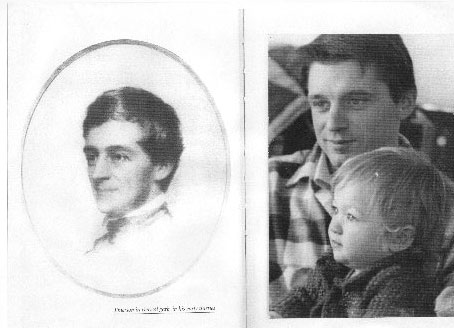
alec and ralph emerson

Ralph Waldo Emerson (left) in his 30's. Alec Emerson at 35 and young friend (right), 1982.


What have you done since your decision to write again?

I finished and published a book of 33 pieces called Connected Words. I've also recorded a CD, also called Connected Words, of both my books.

What other ways do you share your poetry?

In a way I am a "closet writer" that doesn't aggressively seek poetry performances. I am now being more active, on a learning curve so the speak, to join more public venues. I am doing this to show others what poetry actually is. This I take as a responsibility... especially because individual voices need to be heard for a democracy to function properly.

Do you have a favorite piece from your recent work?

Kind of... because it has an unusual compass for a tragic event. On the Saturday following 9/11, I was pacing around my cabin and wondering if it were impossible or arrogant or obscene to try to write about what I had witnessed on TV that Tuesday. Then a line came to me -- the line was "The ghosts of Wounded Knee welcome you"" ... that was all, but as I thought about the line and wondered what the ghosts were wearing and what they were doing, the rest of the poem emerged. I would like to read it to you:

World Trade Center

The ghosts of Wounded Knee
welcome you.
They are quiet and gentle.
No one has young eyes.

Their clothes are neatly patched,
their moccasins carefully repaired.
It happens to be their rotation as guides
in the museum of atrocity.

Last week it was Dresden's turn,
the week before, My Lai.
The week before, Tirana Square,
the week before, Nagasaki,
the week before, Guernica.

Next Tuesday, a small ceremony
will mark the opening of
the World Trade Center.

The ghosts of Wounded Knee
welcome you.

Emerson ended the interview with:
And... I'd like to leave you with a word from Nepal,
"Namaste" which means I salute the great spirit within you.


  November 09, 2005

Brother lost to war inspires poet

By Deborah Medenbach
Times Herald-Record
dmedenbach@th-record.com

Accord — Alec Emerson is fighting the Iraq war with words. Short, poetic and sharp as barracuda teeth, the words pick at images from his brother's death in Vietnam to sound a warning knell for teens ready for ROTC.

Emerson, 57, comes by his craft honestly, as the great-grandson of 19th-century poet Ralph Waldo Emerson. Though Alec lives and works from a serene woodland retreat far off the nearest paved road, you won't find wistful ennui in this pacifist's words.

He jolts listeners at his poetry readings by wearing Iraq war casualty photos on his shirt while reading poems that weave images of the true cost of war.

"My brother Bing was the writer. He flunked out of Harvard his freshman year and spent a lot of time playing guitar. Then my dad told him he should join the Marines," Alec said.

William "Bing" Emerson was a handsome, strapping Marine helicopter pilot with bright eyes and a ready smile in 1968. His father suggested he move from the Marine reserves into active duty. After all, military lessons learned in World War II had deepened his father's character; surely it would give the young writer life lessons as well. A letter offering him a writing job with The New York Times arrived after he was already headed to Quang Nam Province.


Dad

My father used a P-51 to fight fascism.
I use a pen.
Listen to your heart beat.
Choose your weapon.

Alec was thick into his study of organic chemistry as a pre-med student at Harvard when the news came that Bing's helicopter had been shot down. Military reports said the chopper was hit by gunfire and then exploded, killing Bing and seriously injuring two other soldiers. The number of bullets piercing the chopper was "uncountable."

The Best Education

I.

I was at Harvard.
Taking Chemistry 20.
Down the corridor,
a professor worked
to make napalm stickier.

The Vietnamese had learned
to scrape it off
their pajamas.

DOW Chemical wanted
an improved product.

The professor worked,
diligently,
to preserve the torch
of liberty,
and finally got it right,
so it would burn
to the bone.

II.

The telephone rang.
It was my mother.
Breaking.
A body bag, was coming home.


[TOP]


alec and ralph
Bing Emerson 1968.

alec emerson
Alec Emerson. Photo credit: Deborah Medenbach.

Alec's life changed direction when his large family gathered to lay his brother to rest. A lone comfort to his grieving parents was the idea that their son had died a war hero.

Alec and his remaining two brothers and four sisters dealt with their grief in their own ways. Alec burned the 21st- birthday letter from his brother that he had received shortly before the crash. It was their last communication. "Too painful to keep — too sacred to throw away. But the words burned in, as the flame died out," Alec later wrote about that day.

He graduated from Harvard a year after his brother's death. He has had a number of careers over the years, but put all his projects on hold in the late 1990s. Feelings, images and a sense of the lost brother of his youth came acutely to his memory's surface. He wanted to take time to explore it.

Youth

My brother lives in memory
an eternal youth,
looking like a photograph
taken before time
and bullet
stopped in Vietnam.
He was my older brother then,
before we heard of Vietnam,
before he went,
before the telephone rang with pain.
Then I helped,
to bury him.
I am his older brother, now.
He hasn't aged a day,
since his last breath,
across a world,
blew
my youth
away.

Alec resolved in 2000 to commit 10 years of his life to writing poetry. Five years into his journey, he's published two books of poetry, "Somber Reunion" and "Connected Words." The Vietnam and Iraq wars honed the tone of both books.

"The two books of poems are where I stand on the subject. It's where I go with it. I'm going to the open mike nights to work on my public speaking skills. I've never been a public person. Never found that niche where I was comfortable," he said.

 
home | articles | poems: [ANOTHER VICTORY, BY GEORGE!] [CONNECTED WORDS] [SOMBER REUNION] | new poems | 2008 poster
2007